Master Plan Layout & Land Use
The township is organised into seven functional blocks, each with a distinct elevation tuned to its purpose. The 53-floor residential cluster anchors the skyline; the lower commercial and institutional blocks frame and serve it. Building the residences tall (165 m) keeps the ground coverage low, freeing the parcel for landscape, podium amenity and the breathing room a township needs.
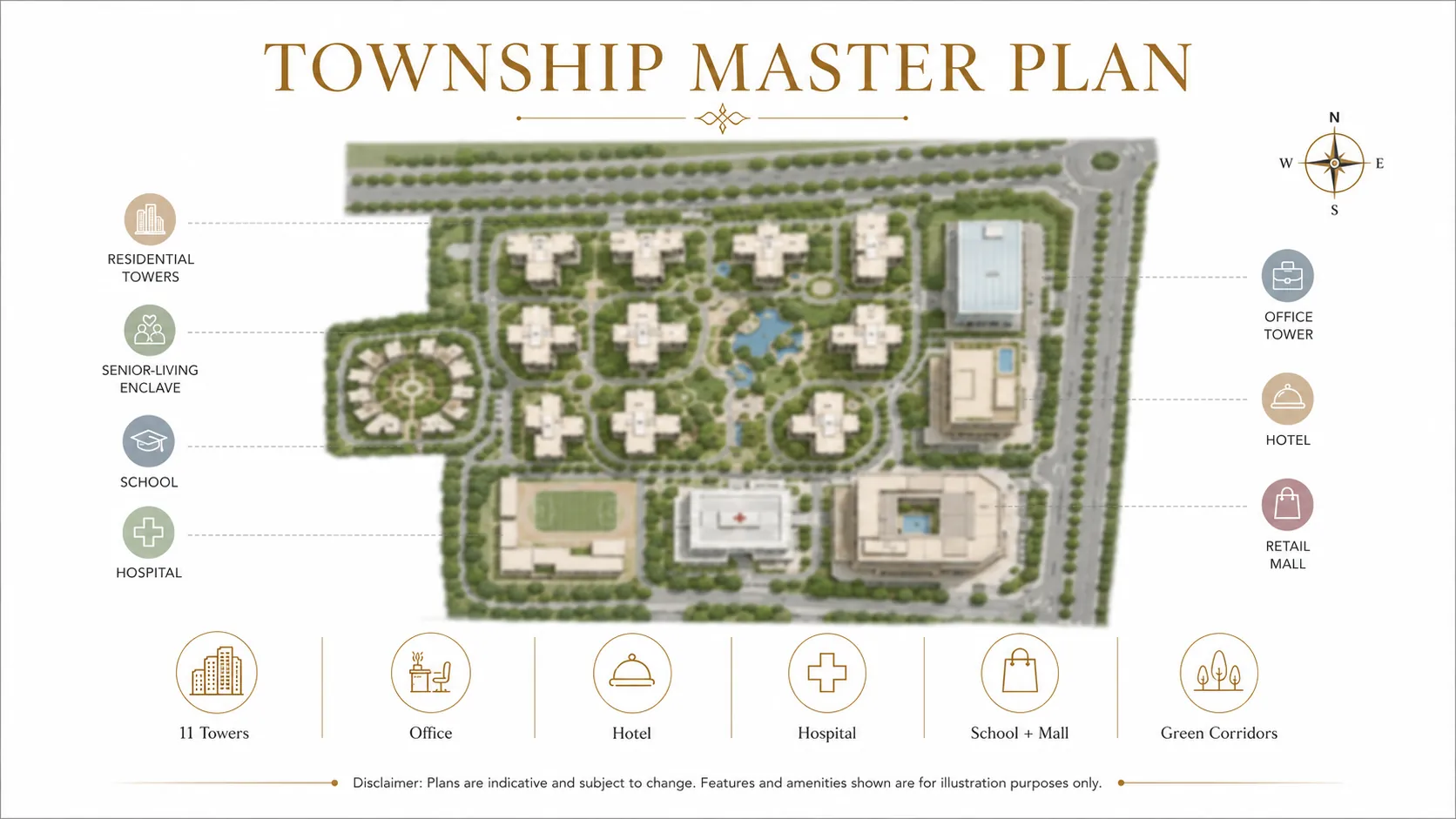
Brigade Old Madras Road — seven-block township master plan
| Block | Elevation | Footprint Role |
|---|---|---|
| Residential (11 towers) | 4B + GF + 53 floors | 5,600 homes + senior living |
| Office | 4B + GF + 35 floors | Grade-A workspace |
| Hospital | 4B + GF + 30 floors | 300-bed multi-specialty |
| Hotel + Convention | 4B + GF + 25 floors | 400-key five-star |
| Senior Living | 4B + GF + 25 floors | Age-friendly residences |
| School | 4B + GF + 10 floors | On-campus K-12 |
| Retail Mall | 4B + GF + 5 floors | Shopping & dining |
Planning Overview: Placement, Green & Circulation
The blocks are positioned to separate incompatible uses while keeping everything walkable. The eleven residential towers cluster around a common landscaped podium and amenity spine, insulated from the commercial frontage; the mall, office and hotel sit toward the road frontage where they draw footfall without routing traffic past residential lobbies; and the hospital and school are sited for easy emergency and pedestrian access yet buffered from the busiest commercial edge.
Low ground coverage translates directly into open space — ground-level courts between towers, an elevated podium garden above the parking, and rooftop and sky-deck greenery, with shaded walking and jogging loops and water features anchoring the central spine. Circulation is multi-modal and segregated: a primary township road takes vehicular traffic to the commercial blocks and residential drop-offs, the four basement levels absorb parking, and separate service routes handle hospital, hotel and mall logistics so they never share the residential streets.
Below-Ground & Sustainability Infrastructure
Four basement levels run beneath the residential cluster, providing multi-level parking sized for a 5,600-home community plus visitors, along with the building services, plant rooms, water tanks, pump rooms and electrical infrastructure a township of this scale demands. Centralising parking below grade is what makes the surface-level open space and pedestrian priority possible.
- Sewage treatment (STP): on-site treatment with treated water reused for landscape irrigation and flushing
- Rainwater harvesting: collection across podium, rooftops and open areas to recharge groundwater
- Energy efficiency: envelopes, glazing and common-area systems designed to cut load, with solar provisioning
- Water security: city-scale storage and distribution that buffers residents from tanker dependence
- Waste management: segregation and on-site processing of the township's solid-waste stream
For the residential product itself — sizes, layouts and configurations — see the floor plans; for the amenity programme that fills these open spaces, see the amenities page.
Brigade Old Madras Road — Building Placement Strategy
The Brigade Old Madras Road blocks are positioned to separate incompatible uses while keeping everything walkable. Three placement principles drive the layout. Residential calm at the core: the eleven residential towers are clustered to share a common landscaped podium and amenity spine, insulated from the commercial frontage. This gives homes the quiet of a gated residential enclave even though they sit inside a mixed-use township. Commercial and institutional on the active edge: the mall, office and hotel blocks are placed toward the township's primary road frontage, where they can draw footfall and traffic from Old Madras Road without routing that traffic past the residential lobbies. This is the single most important planning decision in any township — keeping commercial circulation off residential streets.
Care and learning in accessible, calm zones: the hospital and school blocks at Brigade Old Madras Road are sited for easy emergency and pedestrian access yet buffered from the busiest commercial edge, so that ambulances and school drop-offs flow cleanly without crossing the retail and office traffic. The result is a master plan where the three most sensitive user groups — families with school-going children, patients and their visitors, and residential households — all get the calm and accessibility their daily life needs, while the commercial energy that gives the township its vibrancy still finds its proper home along the active frontage.
The vertical strategy is intentional. By building the residences tall (165 m), Brigade keeps the ground coverage of the homes low, freeing the parcel for landscape, podium amenity and the breathing room a township needs. Taller residential cores also lift the bulk of apartments above the corridor's traffic, noise and dust, with views opening toward the lakes and tech-park skyline of East Bengaluru. The lower commercial and institutional blocks deliberately frame the residential cluster rather than compete with it, producing a coherent skyline where the residential towers read as the address's primary visual identity.
Brigade Old Madras Road — Pedestrian Networks & Green Belt
The walk-to-work, walk-to-school promise at Brigade Old Madras Road only works if walking is genuinely pleasant, so the pedestrian network is treated as primary infrastructure rather than an afterthought. Wide, shaded walkways connect the residential towers to the office block, the school, the mall and the clubhouse. The elevated podium creates a car-free upper deck where children can move safely between play areas, the pool and the community centre. Landscaping uses native and low-water species suited to Bengaluru's climate, reducing irrigation load while keeping the campus green year-round.
Low ground coverage from the high-rise strategy translates directly into open space. The Brigade Old Madras Road master plan layers greenery across multiple levels: ground-level landscaped courts between the residential towers, an elevated podium garden connecting the residential blocks above the parking basements, and rooftop and sky-deck greenery on the towers themselves. Shaded walking and jogging loops thread through the landscape, and water features anchor the central spine. The intent is a continuous green experience — a resident should be able to move from lobby to clubhouse to school drop-off largely under tree cover and along landscaped paths rather than across parking lots.
The single most important circulation principle in a mixed-use township is keeping incompatible traffic streams apart, and the Brigade Old Madras Road master plan achieves this through three independent networks. Residential vehicular traffic enters via dedicated drop-offs and descends directly into the basements, keeping the surface clear. Commercial and visitor traffic for the mall, office and hotel routes along the active road frontage without ever passing residential lobbies. And service traffic — hospital supply and ambulances, hotel and mall logistics, waste removal — runs on separate service roads and entries. The result is that a resident walking from tower to clubhouse never crosses a delivery truck or a patient ambulance, and the commercial footfall that gives the township its vibrancy never compromises the calm of the homes.
Brigade Old Madras Road — Phasing & Small-City Planning
A township of this scale is necessarily built in phases, and how Brigade Old Madras Road is phased matters to early buyers. The logical sequence prioritises the residential towers and the core amenities (clubhouse, pool, landscape) that residents need from day one, with the commercial and institutional blocks — hospital, school, mall, hotel, offices — sequenced to come online close to residential possession so the township's value proposition is realised rather than deferred. Buyers should confirm the specific phase their tower sits in and the scheduled delivery of the non-residential blocks relative to their handover, because a township's premium depends on the supporting infrastructure arriving in step with the homes. Brigade's delivery record and its in-house ability to build and operate each block lower the risk that any phase stalls.
The Brigade Old Madras Road master plan must account not only for 5,600 resident households but for a daytime population that swells with office workers, hospital staff and patients, school students and families, hotel guests and mall visitors. This is genuinely small-city planning. The zoning concentrates that daytime activity on the commercial edge and the institutional blocks, leaving the residential precinct and its podium as a calmer core. Utility infrastructure — water, power, sewage, parking — is sized for the peak combined load, not just the residential count, which is why the city-scale systems below ground matter. Getting this balance right is the difference between a township that feels vibrant-yet-livable and one that feels congested; the segregated-zoning approach is designed for the former.
Read together, these decisions produce the township's core value at Brigade Old Madras Road: a resident's daily radius collapses to a walk. The office is in the township; the school is in the township; a 300-bed hospital is in the township; the mall and the five-star hotel are in the township. The master plan's zoning ensures that delivering all of this never costs the homes their quiet or their open space — an outcome that is as much about restraint and discipline in the planning brief as it is about the size of the parcel and the ambition of the developer.
Brigade Old Madras Road Master Plan — Frequently Asked Questions
Into seven functional blocks, each with a distinct elevation tuned to its purpose: residential (11 towers, 53 floors), office (35 floors), hospital (30 floors), hotel and convention (25 floors), senior living (25 floors), school (10 floors) and retail mall (5 floors).
Building the homes tall (165 m) keeps ground coverage low, freeing the parcel for landscape, podium amenity and breathing room. Taller cores also lift the bulk of apartments above the corridor's traffic, noise and dust, with views opening toward the lakes and tech-park skyline.
Circulation is segregated into three independent networks. Residential traffic descends directly into the basements; commercial and visitor traffic for the mall, office and hotel routes along the active road frontage; and service traffic - hospital supply, ambulances, mall logistics - runs on separate service roads. A resident never crosses a delivery truck or an ambulance.
Low ground coverage from the high-rise strategy translates directly into open space - ground-level landscaped courts between towers, an elevated podium garden above the parking, and rooftop and sky-deck greenery, with shaded walking and jogging loops and water features anchoring the central spine.
Four basement levels provide multi-level parking and house water tanks, pump rooms and electrical infrastructure. Sustainability systems include an on-site sewage treatment plant with treated-water reuse, rainwater harvesting, energy-efficient envelopes, city-scale water storage and solid-waste processing.
A township of this scale is built in phases. The logical sequence prioritises the residential towers and core amenities residents need from day one, with the commercial and institutional blocks sequenced to come online close to residential possession. Confirm the specific phase your tower sits in and the scheduled delivery of the non-residential blocks at booking.